
Who Is Yemaya? Meet the Sacred Mother of Waters, Protection, and Renewal

By Audra English
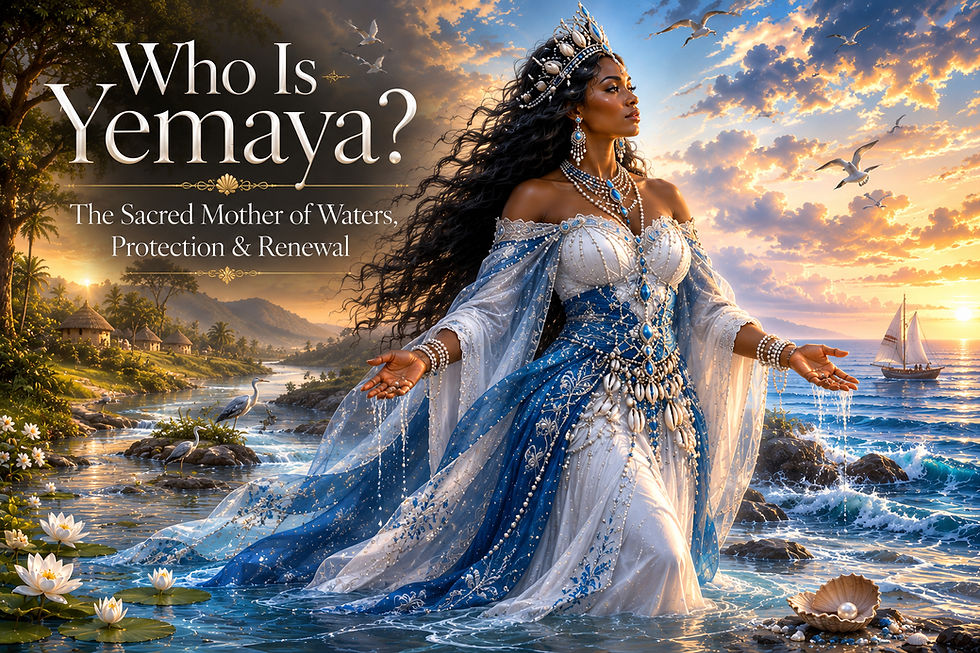
There is something about standing beside a great body of water that changes us.
Perhaps it is the sound of the waves repeating themselves against the shore.
Perhaps it is the horizon reminding us that the world is much larger than whatever has been weighing upon our hearts.
Or perhaps water awakens something ancient within us—the memory that every form of life depends upon it, that our bodies are made from it, and that before we ever took our first breath, we were carried safely within it.
That is the spiritual language I think of when I think of Yemaya.
She is nurturing, but she is not weak.
She is loving, but she is not powerless.
She is the Mother whose waters sustain life, cleanse sorrow, protect what is precious, and remind us that even the deepest emotions are capable of movement.
Yemaya is widely honored as a maternal Orisha connected with water, motherhood, fertility, protection, healing, family, and abundance.
However, her story is much deeper than the simplified description of “ocean goddess” that is often repeated throughout modern spiritual spaces.
To understand Yemaya respectfully, we must begin with her Yorùbá origins, and then follow her waters across the Atlantic, where her name, imagery, and devotional traditions continued to evolve.

How Do You Pronounce Yemaya?
The pronunciation depends partly upon which form of her name and which spiritual or linguistic tradition you are using.
Yemaya is commonly pronounced:
yeh-mah-YAH
You may also hear it pronounced:
yeh-MY-ah
The Spanish-influenced pronunciation yeh-mah-YAH is especially common in Cuban and other Lucumí or Afro-Caribbean contexts.
Her traditional Yorùbá name is usually written Yemọja or Yemoja and is approximately pronounced:
yeh-MOH-jah
The “j” is pronounced like the “j” in jungle.
Yorùbá is a tonal language, so an English sound-out guide can only approximate the full traditional pronunciation. The diacritics in Yemọja carry important information about both vowel sounds and tone, which is one reason the name may sound different when spoken by a native Yorùbá speaker. (Wiktionary)
You may encounter several variations of her name, including:
Yemọja
Yemoja
Yemaya
Yemayá
Yemanjá
Iemanjá
Yemonja

These are not simply random misspellings. They reflect different languages, regions, and diasporic traditions through which devotion to her has traveled.
Throughout this article, I will primarily use Yemaya, because it is the name most familiar to many of my readers, while also using Yemọja when discussing her traditional Yorùbá origins.
Who Is Yemaya?
Yemọja is an Orisha within the traditional religion of the Yorùbá people of West Africa.
An Orisha is not merely a fictional mythological character or a decorative goddess archetype.
Orishas are sacred spiritual powers honored within living religious traditions. Depending upon the tradition and translation being used, they may be described as divinities, sacred forces, spirits, or manifestations through which divine power operates. (World History Encyclopedia)
Yemọja is especially associated with:
Water
Motherhood
Pregnancy and fertility
Women and children
Protection
Nurturing
Emotional depth
Healing
Family
Life, creation, and continuity
She is often understood as a profoundly maternal presence, a mother whose love can comfort, shelter, nourish, and fiercely defend.
Yet calling her maternal should never be confused with making her passive.
Water can soothe a fever, feed a field, or carry a child safely within the womb.
It can also break stone, swallow cities, and reshape an entire coastline.
Yemaya contains both truths.
She is the tenderness of the water that holds you and the force of the wave that refuses to let what she loves be destroyed.

What Does the Name Yemọja Mean?
Her name is often explained as a contraction of the Yorùbá words connected with mother, child, and fish.
It is commonly translated as:
“Mother whose children are the fish”
or
“Mother of fish children.”
This phrase expresses the vastness of her motherhood. Her children are imagined as being as numerous as the fish within the waters, beyond easy counting and spread throughout the living world. Academic discussions of Yemọja also connect this name with her fertility, maternal authority, and relationship with the Ogun River in Nigeria. (Journals)
There is something profoundly beautiful about that image.
A mother with children too numerous to count.
A maternal presence vast enough to hold many lives, many stories, and many generations within her care.

Was Yemọja Originally an Ocean Orisha?
This is one of the most important distinctions to understand.
In traditional Yorùbá religion in West Africa, Yemọja is primarily connected with fresh water and rivers, particularly the Ogun River in Nigeria.
She is not simply the Yorùbá “goddess of the sea.” In traditional Yorùbá cosmology, the great depths of the ocean are more directly associated with Olókun.
As Yorùbá people and their religious traditions were carried across the Atlantic through the violence of the transatlantic slave trade, Yemọja’s identity continued to develop within new lands and new spiritual communities.
In Cuba, Brazil, and other parts of the Americas, her waters expanded symbolically from the river to the sea. She became widely known as Yemaya, Yemanjá, or Iemanjá, the great mother associated with the ocean and its immense life-giving power. (Wikipedia)
This does not mean that one understanding is “real” and the other is false.
It means that religious traditions live, travel, adapt, and preserve themselves under changing historical conditions.
The river mother crossed the ocean with her people.
Across the diaspora, she became Mother of the Sea.
Yemaya Across the African Diaspora
Yemaya is honored in several African diasporic religions and spiritual traditions, although her stories, feast days, colors, offerings, relationships, and ritual customs may differ between them.
These traditions include forms of:
Yorùbá traditional religion and Ifá practice
Lucumí and Santería in Cuba
Candomblé in Brazil
Umbanda in Brazil
Related Orisha traditions throughout the Caribbean and the Americas
In Brazil, she is commonly called Iemanjá and is one of the most publicly recognized Orixás.
Large celebrations are held in her honor, with devotees carrying flowers and gifts toward the sea. Her image has become deeply woven into Brazilian art, religion, music, public celebration, and cultural memory. (The Museum of Modern Art)
In different diasporic traditions, Yemaya may also be associated through religious syncretism with particular forms of the Virgin Mary. These associations developed partly because enslaved Africans were often forced to conceal or reinterpret their traditional religious practices beneath Catholic imagery.
That history matters.
What may look from the outside like a simple blending of symbols was also an extraordinary act of spiritual survival.
Is Yemaya the Mother of All Orishas?
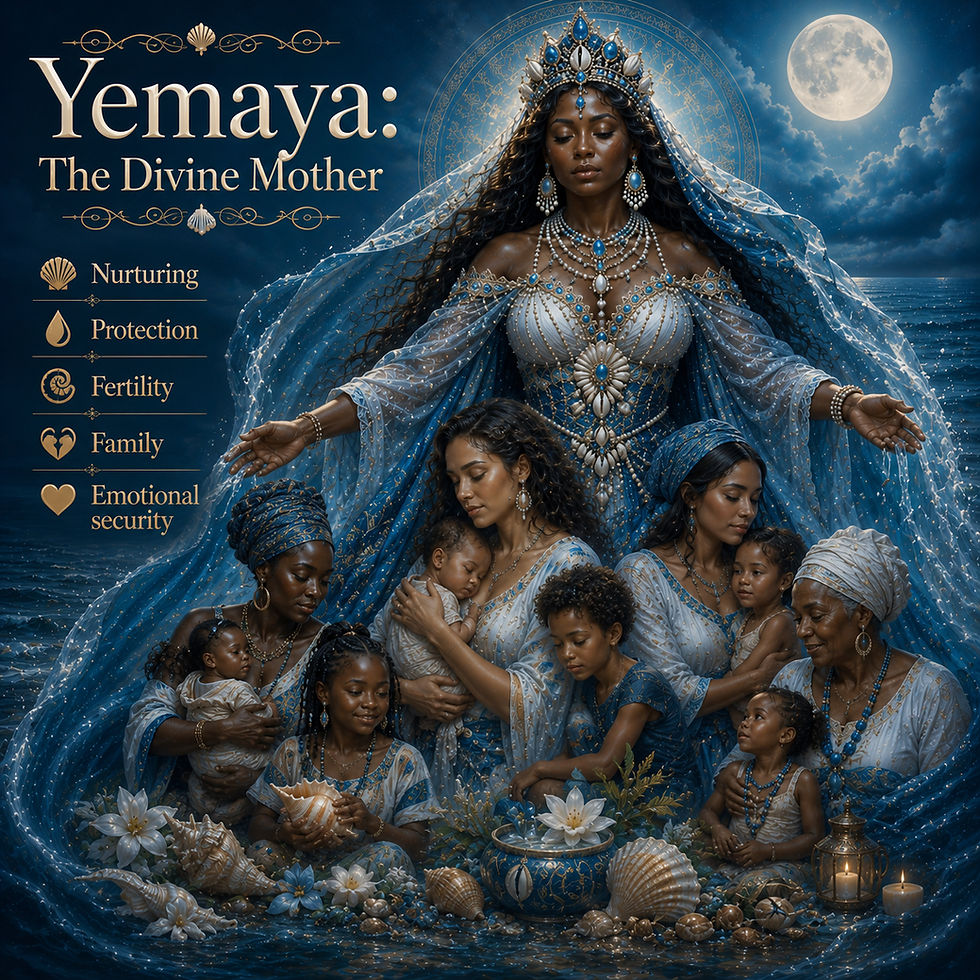
Yemaya is frequently described as the mother of the Orishas, the mother of many Orishas, or the mother of living things.
The precise stories and family relationships vary between regions, lineages, and religious traditions. There is no single universal mythology followed identically by every devotee.
That variation is normal within oral and living religious traditions.
The deeper truth carried through these stories is her extraordinary maternal scope.
She represents the power that brings forth life, sustains it, protects it, and continues loving it through every changing season.
This is not motherhood reduced to sweetness.
It is motherhood as creation.
Motherhood as guardianship.
Motherhood as emotional intelligence.
Motherhood as the sacred responsibility to nourish life without surrendering the power necessary to protect it.
What Is Yemaya the Orisha Of?
Yemaya is most often approached for spiritual matters involving the waters of life—both literal and symbolic.

Motherhood and Children
She is closely connected with maternal protection, pregnancy, birth, caregiving, and the well-being of children.
Many people are drawn to Yemaya when praying for:
Protection over a child
Strength during motherhood
Fertility or pregnancy
Healing within a mother-child relationship
Wisdom for parenting
Emotional safety within a family
Blessings for future generations
Her maternal energy may also speak to adoptive mothers, grandmothers, guardians, foster parents, caregivers, and those who provide genuine mothering beyond biological relationships.

Fertility and Creation
Fertility is not limited to pregnancy.
It is also the ability to bring something into being.
A book.
A business.
A home.
A work of art.
A new identity.
A healthier family pattern.
A completely different future.
Yemaya’s waters symbolize the protected space in which new life develops before it becomes visible. She reminds us that creation often requires patience, nourishment, privacy, faith, and time.

Emotional Healing
Water is one of humanity’s oldest symbols of emotional cleansing and renewal.
Yemaya is therefore often approached for matters involving:
Emotional exhaustion
Grief
Heartbreak
Inner peace
Emotional security
Self-compassion
Release
Renewal
The courage to begin again
Her energy does not tell us to deny what we feel.
It teaches us to allow emotion to move.
A feeling that moves can change.
A feeling we are forced to imprison often becomes an ocean trapped inside the body.
Home and Family
Because Yemaya is so deeply connected with motherhood, protection, and emotional security, many people also associate her with the blessing of the home.
Her symbolism is particularly meaningful for spiritual work involving:
Household peace
Family harmony
Protection of loved ones
Emotional safety
New-home blessings
Healing family patterns
Stronger boundaries
A peaceful place to rest and recover
A home blessed beneath Yemaya’s waters is not a home where conflict is simply hidden.
It is a home where love and dignity are protected strongly enough for honesty, rest, and real emotional security to exist.

Protection
The maternal waters are not defenseless waters.
Yemaya is frequently understood as fiercely protective of those within her care.
Her protection may be sought for:
Mothers
Children
Families
Pregnant women
Travelers
Homes
Emotional boundaries
People moving through vulnerable transitions
She teaches a form of protection that is both tender and formidable.
A safe harbor is peaceful precisely because something powerful stands between it and the storm.

Abundance and Provision
The waters sustain entire worlds.
They carry food, movement, fertility, trade, nourishment, and life itself.
For this reason, Yemaya may also be associated with abundance, but hers is not merely the glittering fantasy of receiving money overnight.
Her abundance is provision.
Food on the table.
A protected home.
Steady resources.
A business capable of supporting a family.
Enough emotional and material security for life to continue growing.
It is abundance that nourishes rather than abundance that merely impresses.

What Are Yemaya’s Symbols?
The symbols associated with Yemaya vary across traditions, but common modern and diasporic imagery includes:
Rivers
The ocean
Waves
Seashells
Cowrie shells
Fish
Pearls
Boats
Moonlight upon water
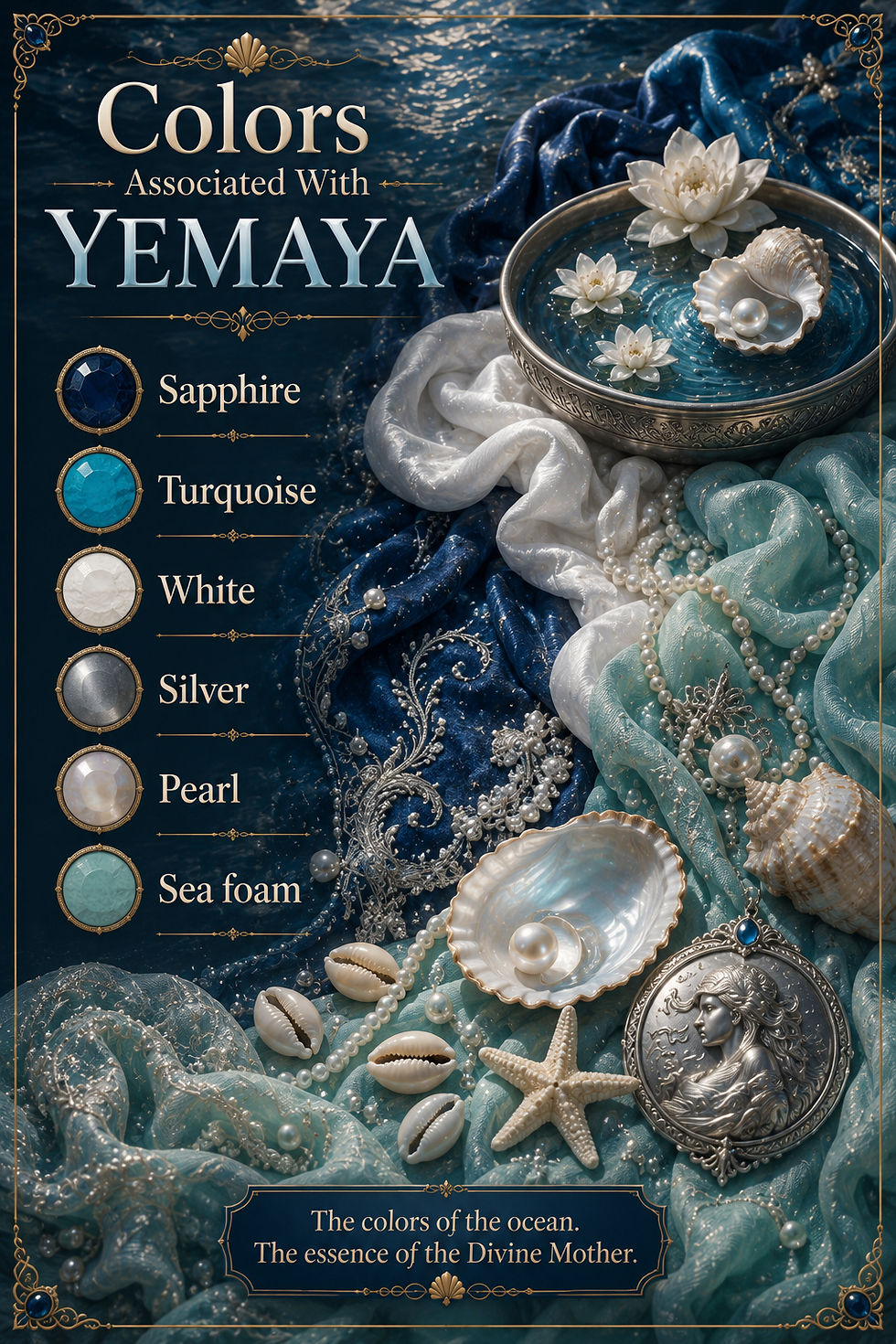
Blue and white fabrics
Silver
Fans
Mirrors
Maternal imagery
Mermaids in some regions and artistic traditions
Cowrie shells have long held associations with water, wealth, divination, femininity, and sacred exchange in many African and diasporic contexts.
Blue and white commonly evoke the movement of water, sea foam, purity, protection, and the shimmering boundary between sky and ocean.
Pearls beautifully symbolize the hidden treasure created within the depths.
However, these correspondences should not be treated as though every community honors Yemaya in exactly the same way. Sacred colors, numbers, ritual tools, foods, songs, and offerings can be specific to particular traditions and initiatory lineages.

Is Yemaya Connected With the Moon or Cancer?
Many modern spiritual practitioners feel a natural symbolic connection between Yemaya, the Moon, and the zodiac sign Cancer.
That connection makes intuitive sense.
Cancer is associated in modern astrology with:
The Moon
Water
Motherhood
Home
Family
Emotional security
Protection
Memory
Ancestry
Nurturing
New life
These themes harmonize beautifully with many of the qualities associated with Yemaya.
However, it is important to make the distinction clearly:
Yemaya is not traditionally a “Cancer goddess” from Yorùbá religion.
Connecting her with Cancer season or a Cancer New Moon is a modern spiritual correspondence.
It can be meaningful when presented respectfully, but it should not be mistaken for an ancient or universal Yorùbá teaching.
In my own practice, I find that the Cancer New Moon provides a beautiful seasonal threshold through which to reflect upon Yemaya’s themes of emotional renewal, family protection, home blessing, fertility, creation, and sacred new beginnings.
I do not believe respect requires us to stop finding new meaning.
I believe it requires us to be honest about where tradition ends and our personal symbolic interpretation begins.

What Can Yemaya Teach Us?
The most powerful sacred figures do more than grant requests.
They change the way we understand life.
Yemaya teaches that tenderness and power were never opposites.
She teaches that emotions are not weaknesses to be conquered but waters that must be understood.
She teaches that motherhood is not merely biological. It is the sacred labor of protecting, feeding, guiding, and helping life become what it was meant to become.
She teaches that abundance should sustain something.
She teaches that boundaries can be loving.
She teaches that grief moves in tides.
She teaches that beginning again does not require pretending the past never happened.
The ocean never returns the shoreline to exactly what it was before.
It reshapes it.
Softly on some days.
Violently on others.
But always through movement.

How Can Someone Honor Yemaya Respectfully?
Because Yemaya belongs to living religious traditions, approaching her should begin with humility.
That does not mean you must be afraid to learn about her.
It means you should resist reducing her to an aesthetic, a personality quiz result, or a convenient collection of spiritual correspondences detached from the people and traditions who have preserved devotion to her.
Respectful beginning points may include:
Learning about her Yorùbá origins
Recognizing differences between Yorùbá and diasporic traditions
Speaking her name with care
Offering sincere prayer or gratitude
Keeping a clean bowl or glass of fresh water as a symbol of reflection
Caring for mothers, children, families, or vulnerable people
Protecting natural waters
Supporting Black and African diasporic scholars, artists, and practitioners
Avoiding claims of initiation, authority, or traditional priesthood you do not possess
Seeking guidance from initiated practitioners for lineage-specific ceremonies
Some traditional rituals, songs, divination methods, sacred objects, and offerings belong within trained or initiated religious practice.
Not everything sacred must be copied in order to be appreciated.
Sometimes respect looks like listening.
Sometimes devotion looks like gratitude.
Sometimes the most meaningful offering is becoming more protective of life.
A Simple Reflection With Water
For a quiet personal reflection, place a clean glass or bowl of fresh water before you.
Sit peacefully for several minutes.
Think about what water makes possible.
Think about everything in your life that has been sustained by care you may not always have noticed.
Then speak from your heart.
You might say:
Yemaya, sacred Mother of Waters, I honor the life-giving power you represent. Thank you for the waters that sustain life, for the love that protects what is still growing, and for the wisdom that teaches us when to hold on and when to release. May I walk with greater compassion, stronger boundaries, and deeper gratitude. May the life entrusted to my care be protected and nourished.
This is not intended to imitate a lineage-specific ceremony.
It is simply a moment of acknowledgment, gratitude, and reflection.
The Sacred Mother of Waters
Yemaya cannot be contained within one title.
She is river and ocean.
Mother and protector.
Comfort and power.
Memory and renewal.
She is honored differently across countries, languages, communities, and religious lineages, yet the image of the life-giving Mother of Waters continues to speak across all of them.
Perhaps that is because every human life begins in water.
Perhaps it is because every person understands, somewhere deep within the body, the desire to be held safely while we are becoming.
Or perhaps it is because the ocean teaches the lesson we spend our whole lives trying to remember:
We can be soft without becoming powerless.
We can feel deeply without drowning.
We can honor the past without remaining trapped inside it.
We can release one tide and still trust that another will return.
May Yemaya’s sacred waters remind you that healing can move.
May they protect what you love.
May they nourish what you are creating.
And may they carry you gently toward the shore of your next beginning.


This is beautiful, Audra! Thank you!